Description
| Parameter | Details |
|---|---|
| Target Gas | Arsine (AsH₃) |
| Sensor Type | Electrochemical |
| Detection Range | 0–1 ppm / 0–5 ppm |
| Accuracy | ±2% Full Scale |
| Response Time (T90) | < 30 seconds |
| Output | 4–20 mA |
| Power Requirement | 24 VDC |
| Operating Temperature | -20°C to +50°C |
| Humidity Range | 0–90% RH, non-condensing |
| Alarms | Dual programmable relays |
| Enclosure | Corrosion-resistant, NEMA-rated |
| Certifications | CE, RoHS |
| Manufacturer | PureAire Monitoring Systems |
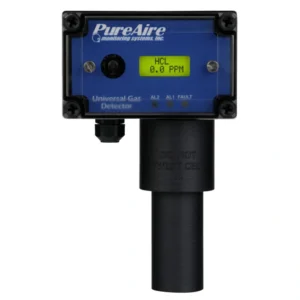
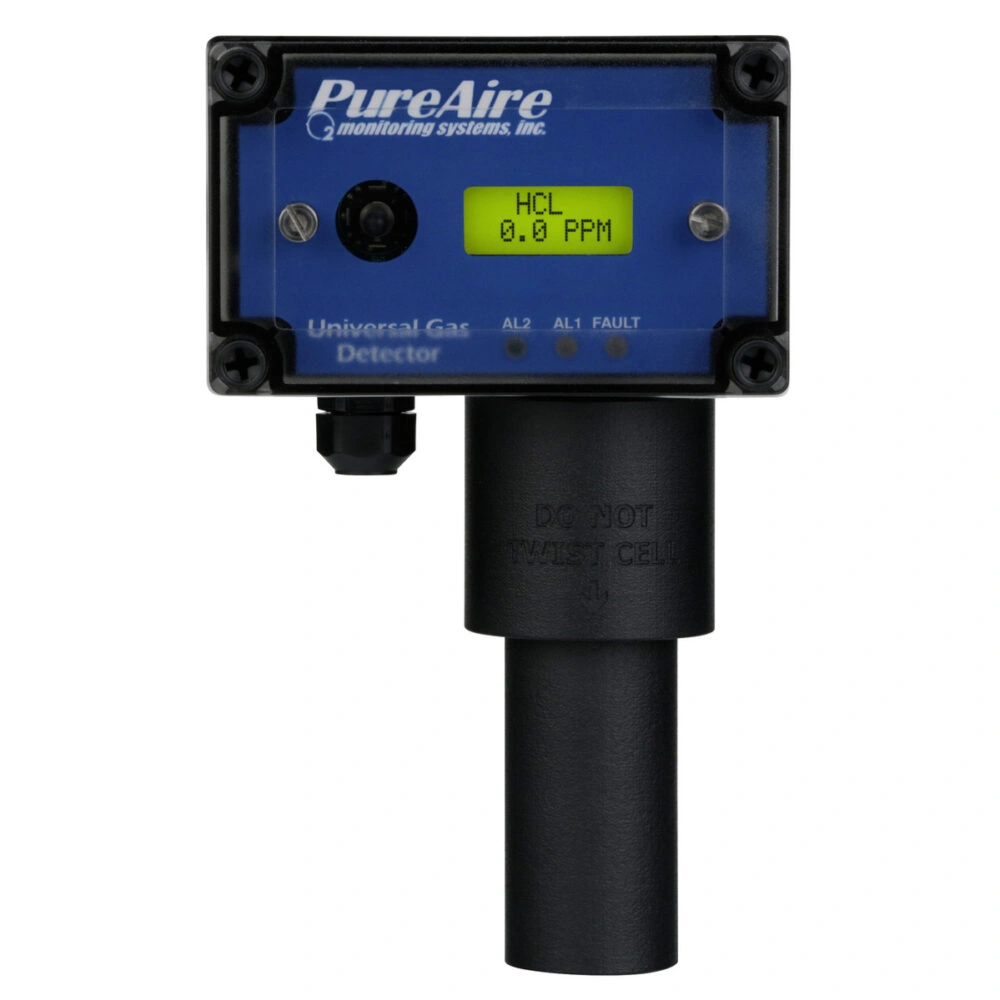
An arsine gas detector is an industrial safety device designed to identify and measure arsine gas (AsH₃) in the atmosphere. Since arsine is a highly toxic, colorless gas used in semiconductor processes, even a tiny leak can cause severe health risks or contaminate sensitive cleanroom operations. A high-quality arsine gas sensor continuously monitors the air, converting chemical reactions with arsine into electrical signals that reflect concentration levels.
This real-time data allows safety teams to act instantly if gas levels rise, ensuring worker protection, compliance with industrial hygiene regulations, and uninterrupted critical manufacturing processes. The PureAire Arsine Gas Detector, equipped with long-life electrochemical sensing, offers a dependable solution for high-purity environments where precision and reliability are essential.
A gas detector works by using a sensing element that reacts chemically with the target gas. The reaction generates an electrical signal that increases with gas concentration. In electrochemical detectors, gas molecules trigger electron transfer within the sensor, producing a measurable current. The detector then translates this signal into ppm readings and triggers alarms if thresholds are exceeded.
Modern gas detection technologies use several sensor types, including electrochemical sensors, IR sensors, PID sensors, catalytic bead sensors, and semiconductor sensors. Each is used for different gases and applications. For toxic gases like arsine, electrochemical sensors are preferred because of their accuracy and fast response time.
A gas analyzer measures the concentration of gases in an environment, often using IR absorption, electrochemical reactions, or thermal conductivity. Gas detectors generally fall under four categories:
-
Electrochemical (toxic gases)
-
Catalytic bead (flammable gases)
-
Infrared (CO₂ and hydrocarbons)
-
Photoionization detectors (VOCs)
The UAE and GCC are expanding rapidly in semiconductor manufacturing, pharmaceutical R&D, aerospace engineering, and nanotechnology—all of which use arsine gas. With AsH₃ being extremely toxic and used in trace-level doping processes, even micro-leaks can jeopardize cleanroom integrity, damage high-value equipment, and risk worker health.
The region’s movement toward world-class safety standards makes reliable arsine gas monitors indispensable in modern industrial infrastructure.
Protect your facility with the most reliable arsine gas detector engineered for high-purity industries.
At Gas Detectors UAE, we are the authorised distributor of Pureair and leading hydrogen gas detection suppliers in the UAE.
Contact us now for pricing, expert guidance, and fast delivery across the UAE & GCC.