
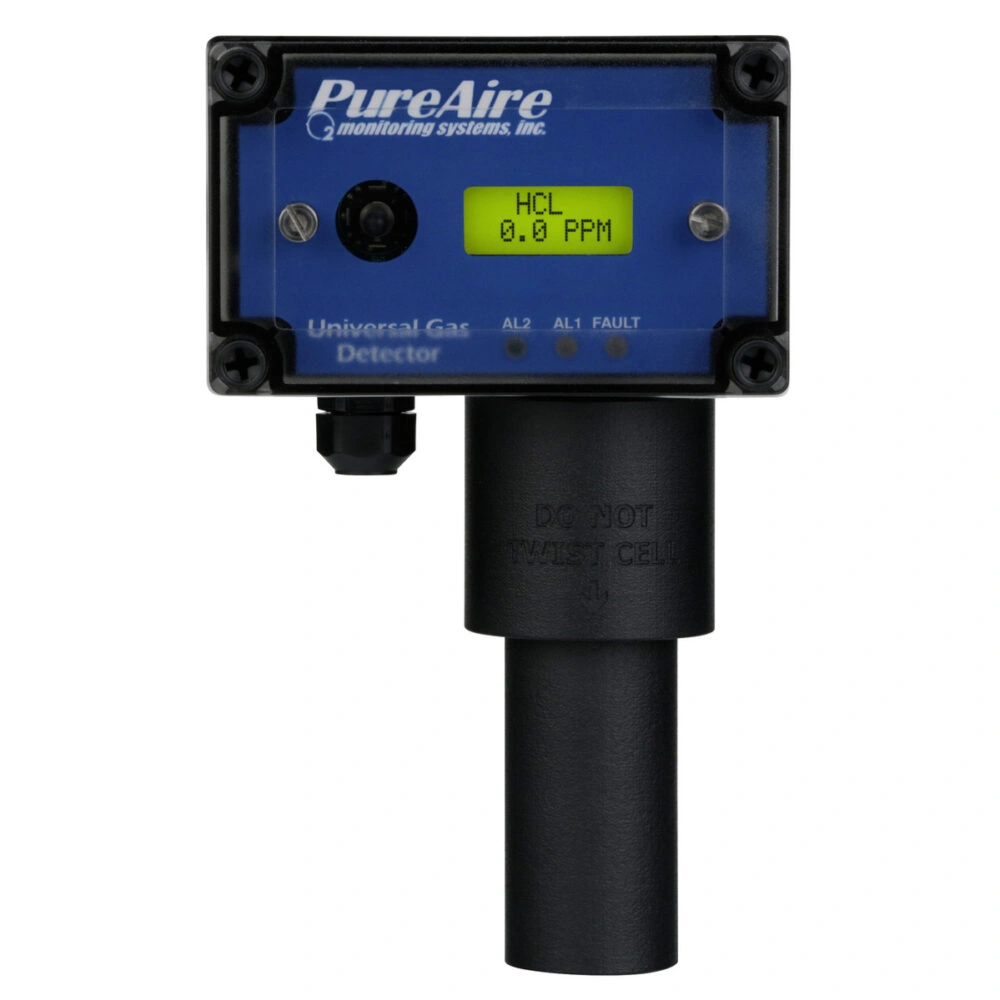
Description
| Feature | Specification |
|---|---|
| Gas Detected | Iodine (I₂) |
| Detection Range | 0–1 ppm |
| Sensor Type | Electrochemical |
| Accuracy | ± 2% of full scale |
| Output Signal | 4–20 mA |
| Power Requirement | 24 VDC |
| Display | Digital LCD |
| Operating Temperature | 0°C to +50°C |
| Humidity Range | 0–95% RH (non-condensing) |
| Dimensions | 5.5” × 4.5” × 2.5” |
| Certifications | CE, RoHS |
| Manufacturer | PureAire Monitoring Systems, Inc. |
Iodine gas is a violet-colored vapor with a sharp odor, produced when solid iodine is heated. It is commonly used in the pharmaceutical, semiconductor, and chemical industries. However, iodine vapors are hazardous to human health and can irritate eyes, lungs, and skin. Exposure to iodine gas can also corrode sensitive components and contaminate production environments. Thus, continuous monitoring using an iodine gas detector is essential for ensuring a safe and compliant workspace.
A gas sensor is a device that detects and measures the concentration of gases in the air. It converts the chemical presence of gas into an electrical signal, allowing users to monitor toxic or combustible gases in real time.
Gas sensors work by detecting the chemical interaction between the target gas and a sensing element. Depending on the type—electrochemical, infrared (IR gas sensor), or catalytic—the sensor generates a signal proportional to the gas concentration, which is then displayed or used to trigger alarms.
There are four main types of gas detectors:
-
Electrochemical sensors – for toxic gases like iodine and chlorine.
-
Infrared (IR) sensors – for hydrocarbon or CO₂ detection.
-
Catalytic bead sensors – for combustible gases.
-
Photoionization detectors (PID) – for volatile organic compounds.
Each type serves specific safety applications in industrial settings.
In the UAE and GCC, industries like semiconductor manufacturing, aerospace MRO, and pharmaceuticals are rapidly expanding. These high-value facilities require strict environmental controls to prevent contamination and protect workers. The PureAire Iodine Gas Detector supports this mission by ensuring reliable, 24/7 safety monitoring.
With the UAE’s commitment to world-class safety standards under its economic diversification strategy, adopting advanced iodine gas monitoring systems is not just best practice — it’s a necessity.
Modern iodine gas detectors rely on electrochemical or ionization detection principles. These detectors identify even trace levels of iodine, ensuring compliance with workplace exposure limits defined in the Iodine Gas MSDS. The ionization detector working mechanism provides fast response times and stable readings, essential for cleanroom and high-purity environments.
Why Choose Gas Detectors UAE?
At Gas Detectors UAE, we are the authorized distributor of PureAire in the UAE. We provide high-quality gas monitoring solutions designed to meet the toughest industrial requirements. Our range of detectors including iodine gas sensors, oxygen gas sensors, and hydrogen gas detectors ensures your facility remains compliant and safe.
Enhance your facility’s safety with the trusted PureAire Iodine Gas Detector from Gas Detectors UAE your authorized PureAire distributor and hydrogen gas detection supplier in UAE.
Reviews
There are no reviews yet.